
01
Texas · map pack top 3
Roofing contractor
Page one on the city replacement term, from position 22.
Google Business Profile
We get US home service contractors into the Google Maps top three, and named when a homeowner asks an AI instead. Every position grid-verified across your whole service area, every month.
Verified client outcomes · June 2026

WWee ppuutt hhoommee sseerrvviiccee ccoonnttrraaccttoorrss iinnttoo tthhee GGooooggllee MMaappss ttoopp 33,, aanndd ggeett tthheemm nnaammeedd wwhheenn aa hhoommeeoowwnneerr aasskkss aann AAII iinnsstteeaadd.. EEvveerryy ppoossiittiioonn iiss ggrriidd--vveerriiffiieedd aaccrroossss tthhee wwhhoollee sseerrvviiccee aarreeaa,, eevveerryy mmoonntthh,, ssoo yyoouu ccaann sseeee eexxaaccttllyy wwhhiicchh zziipp ccooddeess yyoouu oowwnn aanndd wwhhiicchh oonneess yyoouu aarree iinnvviissiibbllee iinn..
1,000
Air conditioning
Inbound leads in a single month, from one profile and one service area.
Top 3
Security installation
Map pack position won on the primary commercial term, and held.
22 → 8
Roofing · US
Off the third page and onto page one on a high-intent replacement term.
250
Removals
Inbound leads in a single month, tracked to call and form.
From client call tracking and rank tracking, verified June 2026. Client names withheld.
Home service contractors who win work inside a drive time. If a homeowner picks you because you came up first and you were close, the map pack is not a channel, it is the channel.
United States · also serving Australia and New Zealand
01
We scan your rankings from a grid of points across your service area, so you see where you actually appear rather than where you appear from your own front door.
02
Categories, services, service area, photos and review velocity rebuilt against what the map pack rewards in your category and city.
03
Content, citations and signals built to widen the radius you can rank inside, zip code by zip code.
04
The same grid, re-scanned monthly, next to the calls and forms it produced. Progress you can check rather than take on trust.
The engagement
No mystery, no black box. This is the sequence we run on every account, in this order, because each step makes the next one work harder.
We measure your Google Maps position from dozens of points laid out across your service area, for the keywords that actually produce booked jobs. That produces a map: green where you hold a top-three position, yellow where you are close, red where you do not appear at all.
Almost every contractor is surprised by this, because a single rank check describes one spot and the map describes the business. It is normal to find you own the zip codes around the shop and are invisible across the half of the metro you built the company to serve.
What you get
You keep this scan whether or not we work together.
We take the three businesses currently holding the pack for your highest-value term and pull apart what Google is rewarding them for. Primary category, secondary categories, service list depth, review rate and recency, what their site says about where they operate.
This is what turns the strategy from opinion into evidence. If all three are filed under a category you are not in, the investigation is over and you have your first fix.
What you get
Sometimes this step finds the whole problem in an afternoon.
Primary and secondary categories set against the benchmark. Every service you sell listed and described, not three of them. Service area set to where your trucks genuinely go, because an optimistic radius dilutes every signal you have across territory you cannot service.
Then the boring, load-bearing part: name, address and phone identical everywhere they appear. Conflicting details cap what the profile can ever rank for, and after a rebrand or a move they are almost always broken somewhere.
What you get
We change one major thing at a time so we can tell what worked.
Reviews get handled as a rate, not a trophy. A contractor with forty reviews arriving every month beats one with three hundred that stopped two years ago, because recency is what Google can read as evidence of a live business.
Since March 2026 Google parses review content for relevance rather than counting stars, so a review that names the service and the city does work that a generic five star does not. We build the request into how your crews already close out jobs, so it keeps running after we stop pushing.
What you get
We never write, buy, incentivize or gate a review.
Proximity is the hardest ranking factor to move, by design, because Google is genuinely trying to show a homeowner what is near them. What we can do is maximize every other signal until your effective radius is two or three times what it was.
That means service pages built around the searches that produce booked jobs, market pages only where you can say something true and specific, citations that corroborate where you operate, and internal links that state the relationship between service and place instead of leaving Google to infer it. Not eighty templated city pages. Google spent the March 2026 core update dismantling those, and home services took the worst of it.
What you get
Fewer pages, each one defensible. We have been hired to clean up the alternative.
The same grid, the same points, the same keywords. That is the whole discipline. If the green area grew, something worked. If average position improved while the green area shrank, you got better where you already won and lost ground where you were marginal, which looks like progress on a chart and is usually worse for revenue.
Next to that sit the calls and forms the rankings produced, because rankings are the input and booked jobs are the output. We have seen a client lose two average positions and gain calls, since the positions lost were in zip codes they did not want.
What you get
Nobody can guarantee a specific ranking. We report what moved instead.
We do not promise a position, build fake locations, buy reviews, or ship eighty city pages with the name swapped. Each of those works briefly and then costs more than it earned. If any of it is already on your account, the first job is usually undoing it.
Categories, services, service area and review velocity set up the way the map pack actually scores. The unglamorous work that decides everything downstream.
Read moreRanking past your own zip code. We build the signals that widen your radius so you show up across the metro you actually run trucks in.
Read moreBeing the company an assistant names when a homeowner asks it who to call. Structured, citable, written to be quoted rather than skimmed.
Read moreFor contractors who have already won their home market and want the rest of the metro. Selective, and by conversation only.
Read moreSelected work
Client names and numbers are withheld — they were getting cold-called from this page. Sector and market only.
Texas · map pack top 3
Page one on the city replacement term, from position 22.
Australia · lead engine
Built to capture and route enquiries across a whole metro service area.
Colorado · storm season
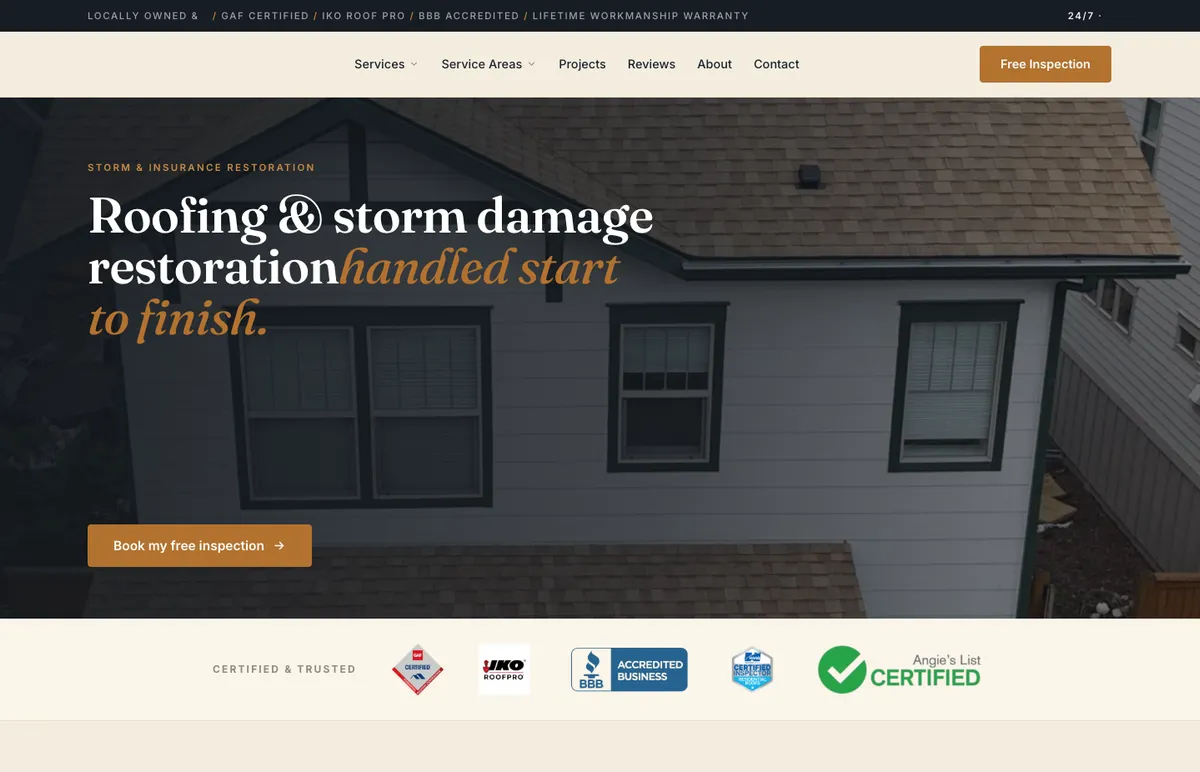
Service-area pages built for the zip codes the crew actually covers.
Most home service contractors see movement within 30 to 90 days, and competitive city terms take longer. Speed depends on your category, how many established competitors sit inside your radius, and how complete your Google Business Profile is when we start. A grid scan tells us which of those is holding you back before any work begins.
The map pack is the block of three local businesses Google shows above the normal results when someone searches for a service near them. It carries the majority of clicks for local service searches, because it sits at the top and shows a phone number, rating and directions without the searcher opening a website.
Google Maps results are calculated from the searcher's location, so your position changes street by street. You can sit at number one from your own office and be invisible three zip codes away. This is why a single rank check is misleading and why we measure on a grid.
A grid scan measures your Google Maps ranking from many separate points spread across your service area instead of from one location. Each point returns the position you hold when someone searches from there, which produces a map of where you win, where you sit below the pack, and where you do not appear at all.
No, and neither can anyone else. Google's own guidelines say to avoid any agency that promises a specific ranking, because nobody controls the algorithm. What we do commit to is grid-verified reporting, so you can see exactly what changed and judge the work on booked jobs rather than on claims.
Primary and secondary category selection, a complete service list with descriptions, an accurate service area, consistent name address and phone details everywhere they appear, photo cadence, product and service posts, and a review process that produces steady recent reviews rather than a burst. Category choice alone frequently decides whether a profile can rank at all.
Yes. When someone asks ChatGPT, Gemini or Perplexity who to call in their city, those systems pull from sources they can read and trust. We structure your site and profile so your business is described clearly enough to be named, and we track which assistants mention you.