
Case file 02 · Med spa and weight loss · Texas metro
Seven keywords, all starting at zero.
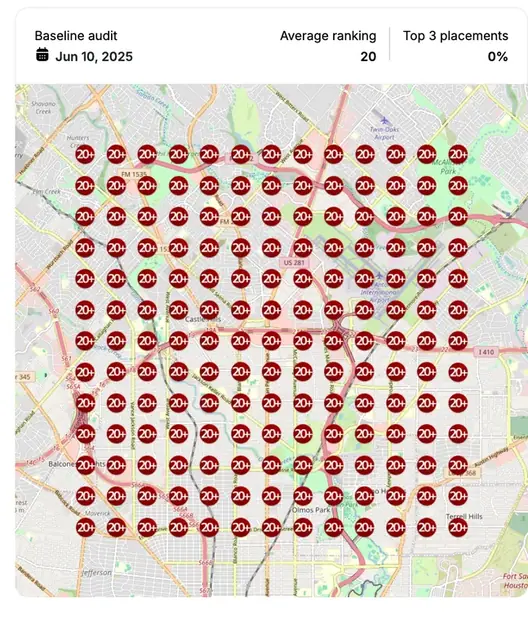
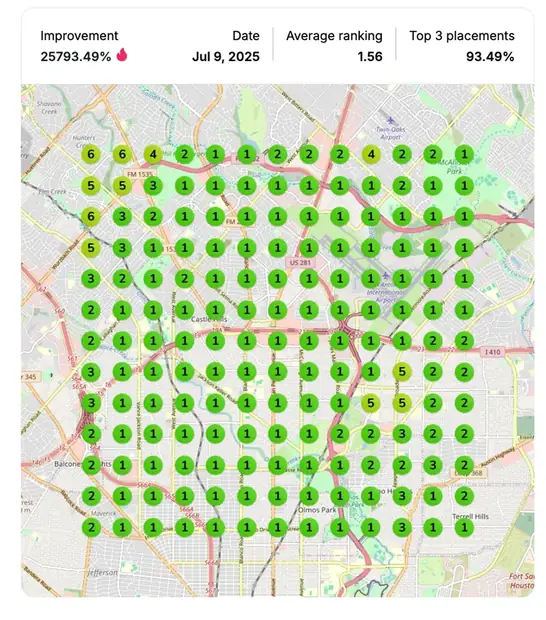
Every tracked term returned the same baseline: the clinic held a top-three position at none of the grid points. Twenty-nine days later one term covered 93.5 percent of the map.
0% → 93.5%
Top-three map coverage
Best keyword, 29 days
7 of 7
Keywords started at zero
All seven finished above it
176 → 695
Website clicks
Up 295%, three months
16 → 50
Phone calls
Up 213%, three months
What that extra demand is worth
$4,700 a month
About $56,000 a year in new program value.
11 calls x 35% close rate x $1,200 program value
Estimated, not invoiced. The leads are measured, the close rate and the job value are assumptions we hold under the industry benchmark. See the whole calculation
"med spa weight loss near me"
Top-three coverage 0% to 93.5%
The situation
What the baseline actually showed.
A zero across every keyword is a different problem from a low number. A low number means the profile is competing and losing. A zero means Google is not putting the business in the running at all, anywhere on the grid, for anything the clinic sells.
That pattern points at eligibility rather than effort. When a profile is filed under the wrong primary category, or its service list does not name the treatments people search for, no amount of review volume moves it, because it is not in the set Google is ranking.
The clinic was selling the exact treatments being searched for in its own metro. The searches were happening. The business was not an answer to any of them.
Goals and measurement window
What we set out to move.
Seven terms were tracked, covering the branded drug names, the generic treatment language and the high-intent local searches that produce booked consults.
- Get on the board at all, which means any top-three coverage above zero
- Take the two highest-volume treatment terms to majority coverage across the grid
- Turn coverage into consults, measured as calls and direction requests to the clinic
- Re-scan twice so the movement is a trend and not a single reading
Measurement window: June to July 2025
What we implemented
The work, in the order it ran.
-
Grid scan and baseline
June 10, 2025
Grid locked across seven terms. Every one returned zero top-three coverage, which made the diagnosis an eligibility question rather than a competitive one.
-
Competitor teardown
Same week
The businesses holding the pack on the highest-value treatment terms were benchmarked. Their primary category, the depth of their service lists and the language they used for each treatment gave the target to rebuild against.
-
Profile rebuild
Weeks one to two
Primary and secondary categories reset to the benchmark. Every treatment listed and described in the language patients actually search, rather than the clinical shorthand used on the wall. Service area set to the real catchment, and name, address and phone made consistent everywhere they appear.
-
Review system
Built in, then ongoing
Review requests attached to appointment close-out, with prompts that encourage naming the treatment and the area. Recency and relevance do work here that raw review count does not.
-
Content and proximity
Weeks two to four
Profile content aligned to the treatment terms so the entity, the services and the searches all describe the same business.
-
Re-scan, report, adjust
June 25 and July 9, 2025
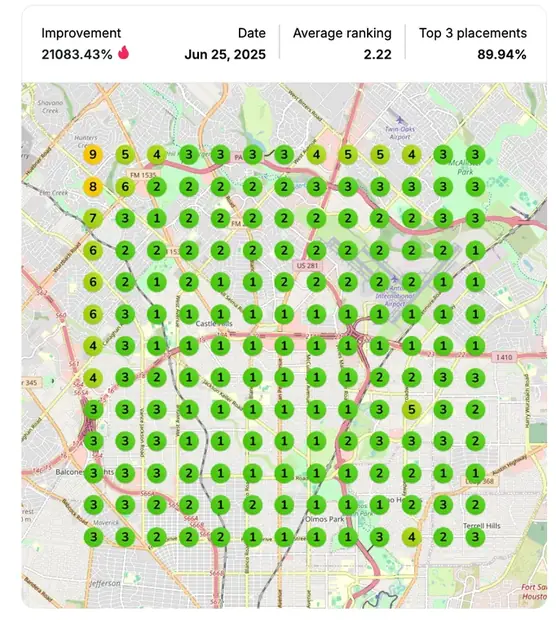
Same grid, twice. The June re-scan showed five of seven terms above 45 percent. The July re-scan took the lead term to 93.5 percent.
This is the same sequence every account runs. See the full process
Before and after
Every keyword we tracked, including the ones that barely moved.
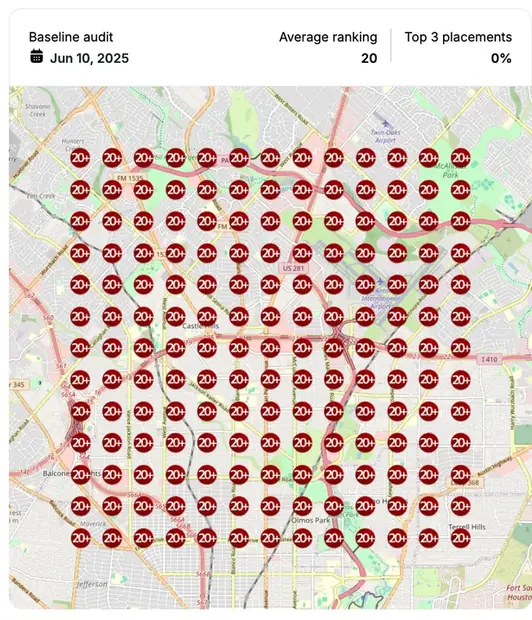
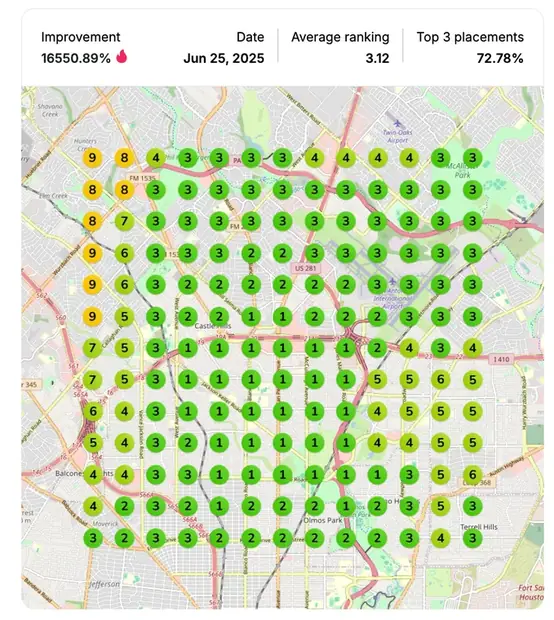
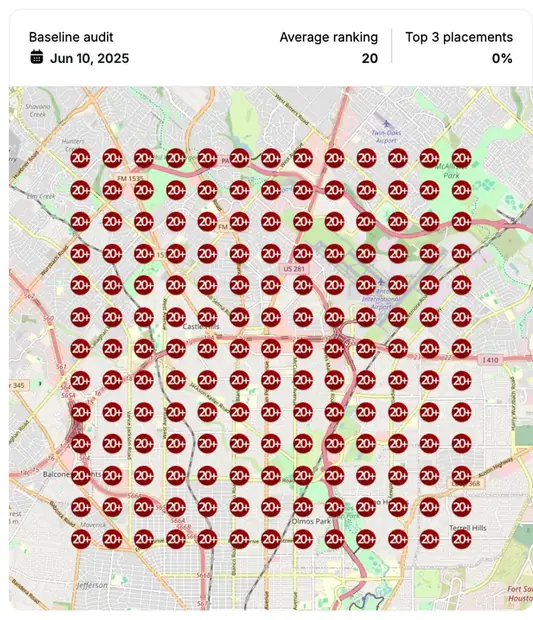
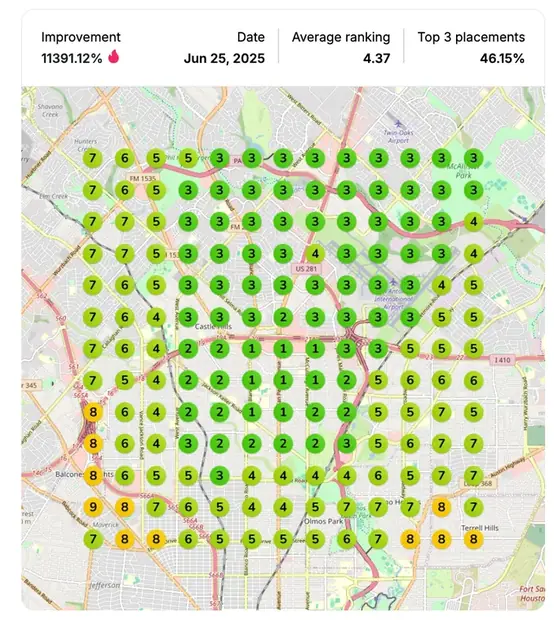
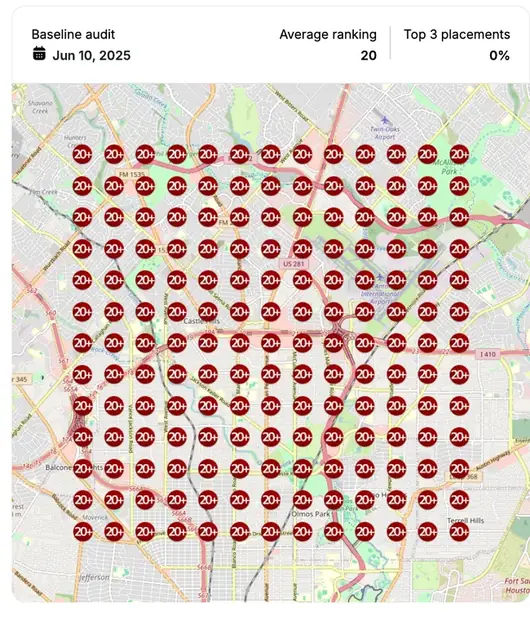
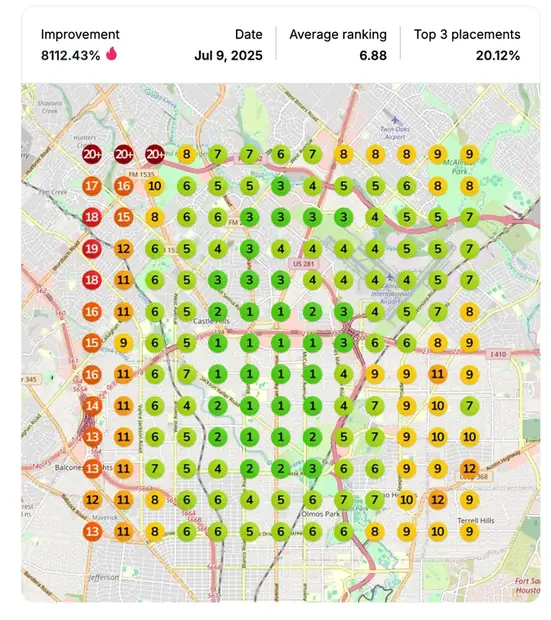
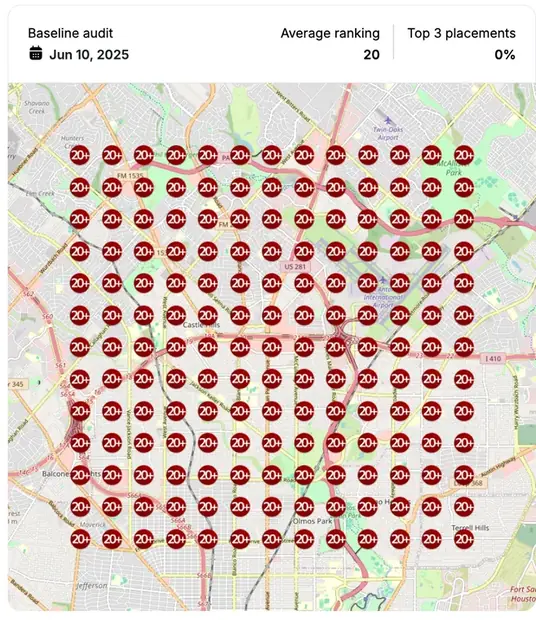
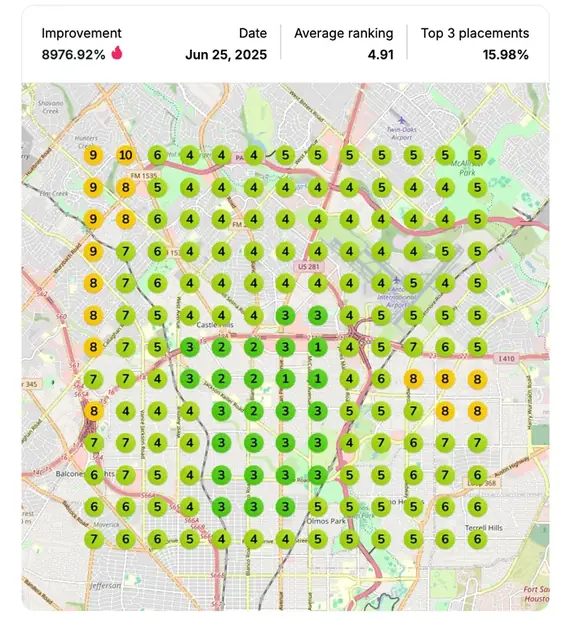
Top-three coverage is the share of grid points where the profile held position one, two or three. Same grid, same points, both dates.
| Keyword | Before | After | Scan dates | Days |
|---|---|---|---|---|
| med spa weight loss near me | 0% | 93.5% | Jun 10, 2025 → Jul 9, 2025 | 29 |
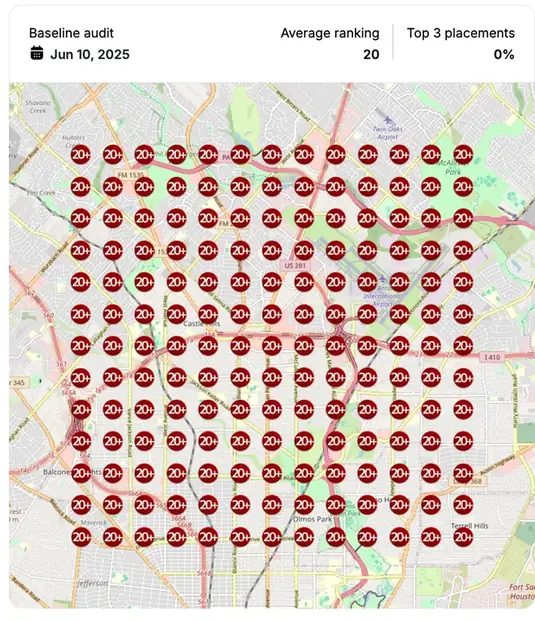
| semaglutide injections near me | 0% | 89.9% | Jun 10, 2025 → Jun 25, 2025 | 15 |
| tirzepatide weight loss near me | 0% | 72.8% | Jun 10, 2025 → Jun 25, 2025 | 15 |
| [city] semaglutide | 0% | 53.2% | Jun 10, 2025 → Jul 9, 2025 | 29 |
| tirzepatide shots for weight loss | 0% | 46.1% | Jun 10, 2025 → Jun 25, 2025 | 15 |
| weight loss clinic | 0% | 20.1% | Jun 10, 2025 → Jul 9, 2025 | 29 |
| medical weight loss injections | 0% | 16.0% | Jun 10, 2025 → Jun 25, 2025 | 15 |
"med spa weight loss near me"
0% → 93.5%
"semaglutide injections near me"
0% → 89.9%
"tirzepatide weight loss near me"
0% → 72.8%
"[city] semaglutide"
0% → 53.2%
![Before grid, "[city] semaglutide", Med spa and weight loss clinic](/grids/grid-14-a.webp)
![After grid, "[city] semaglutide", Med spa and weight loss clinic](/grids/grid-14-b.webp)
"tirzepatide shots for weight loss"
0% → 46.1%
"weight loss clinic"
0% → 20.1%
"medical weight loss injections"
0% → 16.0%
What the coverage produced
Rankings are the input. This is the output.
Read from the client's own Google Business Profile performance panel. Each row compares a period against the period immediately before it, or against the same period a year earlier where the row says so.
| Metric | Before | After | Change | Window |
|---|---|---|---|---|
| Phone calls | 0 | 9 | From zero | Period to June 25, 2025 against the prior period |
| Website clicks | 0 | 94 | From zero | Period to June 25, 2025 against the prior period |
| Direction requests | 0 | 35 | From zero | Period to June 25, 2025 against the prior period |
| Website clicks | 176 | 695 | +295% | Last 3 months against the prior 3 |
| Phone calls | 16 | 50 | +213% | Last 3 months against the prior 3 |
| Direction requests | 46 | 142 | +209% | Last 3 months against the prior 3 |
Source: GBP performance panel
What that demand is worth
The calculation, with every assumption showing.
One number here is measured and two are assumptions. They are laid out separately so you can throw ours away and put your own close rate and your own average job in their place. Your numbers are the only ones that matter.
- +11 calls a month Measured
- Measured. Phone calls went 16 to 50 across three months against the prior three, which is 34 extra calls, or about 11 a month.
- 35% close rate Assumption
- Assumption, held under the benchmark. Invoca puts phone lead conversion at 46% across service businesses. A consult-led clinic can run higher than this once the patient is in the chair.
- $1,200 average job Assumption
- Assumption. Compounded semaglutide programs run roughly $250 to $500 a month in 2026, so this is four months at the bottom of that range. A patient who stays on maintenance is worth several times it.
11 calls x 35% close rate x $1,200 program value
$4,700 a month
About $56,000 a year in new program value.
Read this before you quote the number
This is a model, not an invoice. The lead figure is measured off the client’s own Google Business Profile. The close rate and the job value are assumptions, both held at or below the published benchmark, and both printed above so you can replace them with your own. We did not follow these leads to signed jobs or paid invoices, so this is what the extra demand is worth at those assumptions, not revenue we have verified.
Benchmarks used: Invoca home services lead conversion benchmarks 2026, phone leads convert at 46% · Greenwich Medical Spa, the cost of semaglutide
How this was measured
So you can check it rather than trust it.
Rankings are measured with a geo-grid, not a single rank check. The scanner queries Google Maps from a fixed lattice of points spread across the client’s service area and records the business position at every point. Top-three coverage is the share of those points where the profile holds position one, two or three.
The same grid, the same points and the same keywords are used for the baseline and for every re-scan. Moving the grid between scans would make the comparison meaningless, so the grid is locked at baseline and never changed.
Call, website click and direction request figures are read from the client’s own Google Business Profile performance panel, comparing a period against the immediately preceding period of equal length, or against the same period a year earlier where stated.
Every scan carries its date. Both dates are printed next to every row in the keyword table below, so any claim on this page can be checked against the pair of images it came from.
What these numbers do not say
- These results were selected. They are not typical of every engagement and they are not a forecast of yours.
- Google Business Profile performance figures measure demand reaching the profile. They are not signed jobs and they are not revenue. This page does not claim either.
- Nobody can guarantee a Google ranking. Positions move with competitors, categories, proximity and Google’s own updates.
- A percentage change calculated from a base of zero is not meaningful, which is why the first three rows in the activity table are written as "from zero" rather than as a percentage.
- A profile starting at zero coverage has more room to move than one already competing. The size of the gain here reflects the starting point as much as the work.
Client name, city and profile ID are withheld on every case study we publish. Contractors get called by vendors the moment they show up in a results page, so we do not put them there.